Loading...
tech#diabetes technology#Sugarmate app#Tidepool review
Beyond the CGM: Using Sugarmate and Tidepool to Predict and Prevent Blood Sugar Spikes
Blood Sugar Control
February 21, 20268 min read

I remember the "dark ages" of diabetes management like it was yesterday. It was a world of finger pricks, logbooks filled with smudged ink, and the constant, nagging anxiety of the unknown. When the first Continuous Glucose Monitors (CGMs) hit the market, it felt like someone had finally turned the lights on in a dark room. Suddenly, I wasn't just seeing a single point in time; I was seeing the lines, the curves, and the terrifying cliffs of my blood sugar levels.
But as the years passed and the technology matured, I realized that simply having the data wasn't enough. We have moved from the era of "not enough info" to the era of "data overload." If you’re like me, you’ve stared at your Dexcom or Libre app, seeing a 165 mg/dL with a diagonal up arrow, and felt that familiar sense of paralysis. Do I bolus? Do I wait? Is the sensor lagging?
This is the evolution of the Bionic Pancreas. It’s no longer just about reacting to a high or low; it’s about using sophisticated third-party tools to transition from reactive management to proactive prevention. The standard apps provided by manufacturers are fantastic "training wheels," but to truly master the art of the "flat line," we need to look beyond the native interface. We need tools like Sugarmate and Tidepool to turn raw data into actionable intelligence.
Why Your Native CGM App Might Be Holding You Back
Don’t get me wrong—the Dexcom G6/G7 and Abbott Libre 3 apps are incredible feats of engineering. They are FDA-cleared, reliable, and life-saving. However, because they are regulated medical devices, their interfaces are often designed for the "lowest common denominator" of safety. They are conservative by design.
The first major hurdle is Alert Fatigue. If your phone screams at you every time you hit 180 mg/dL, but you’re already aware of the rise because you just ate a slice of pizza, that alarm becomes a nuisance rather than a help. Eventually, you start ignoring it, or worse, you turn it off entirely.
Furthermore, native apps often lack granularity. They show you the number and a trend arrow, but they rarely emphasize the "Delta"—the specific rate of change over the last five minutes. There is a massive physiological difference between rising at 1 mg/dL per minute and 5 mg/dL per minute, yet many native apps treat them with the same single "up arrow." To prevent a spike, you need to know the velocity, not just the direction.

Sugarmate: The Real-Time Dashboard for Power Users
If you want to feel like a pilot in a cockpit rather than a passenger on a plane, Sugarmate is the gold standard. Sugarmate isn't a CGM itself; it’s a data aggregator that pulls your CGM readings (usually via Dexcom Share) and displays them in a way that makes sense for a busy life.
The Multi-Tile Display
The Sugarmate dashboard is a "power user's" dream. Instead of one big circle with a number, you get a series of "tiles." You can see your current reading, your 24-hour average, your "Time in Range," and most importantly, the Delta. Seeing that "+3" or "-2" next to your number gives you an immediate sense of urgency—or lack thereof.
The Apple Watch 'Calendar Hack'
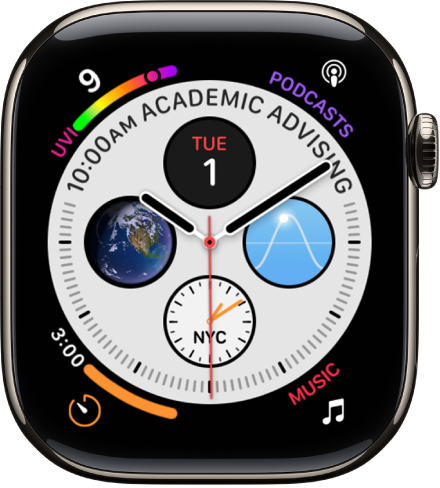
This is the feature that changed my life. One of the biggest frustrations with the Apple Watch is that CGM complications often lag or fail to refresh. Sugarmate solved this with a stroke of genius: it creates a digital calendar that updates your blood sugar as a "current event."
When you look at your watch, your blood sugar is displayed in the calendar slot. Because the Apple Watch prioritizes calendar updates, your sugar is almost always current. You can check your levels with a flick of the wrist during a meeting or while driving without ever touching your phone.
Predictive Alerts and the Emergency Call
Sugarmate doesn't just tell you where you are; it tells you where you’re going. Its predictive algorithm can alert you if it calculates that you will hit a certain threshold in 20 or 30 minutes.
But the "killer feature" for many, especially parents of children with T1D, is the Emergency Call. If your blood sugar drops below a certain level at night, Sugarmate can actually place a physical phone call to your device. For heavy sleepers who have become desensitized to standard app pings, a ringing phone is often the only thing that will wake them up to treat a severe low.
Tidepool: Finding the 'Why' Behind Your Blood Sugar Patterns
While Sugarmate is your co-pilot for the now, Tidepool is your detective for the past. Tidepool is a non-profit, open-source platform that allows you to upload data from almost every diabetes device on the market—pumps, CGMs, and even smart insulin pens.
Transitioning to Pattern Recognition
The "Trends" view in Tidepool is where the magic happens. It overlays multiple days of data on top of each other. This allows you to see that, for example, every Tuesday at 10:00 AM, you spike to 210 mg/dL.
Without Tidepool, you might just think, "Oh, I'm high again." With Tidepool, you realize, "I'm always high two hours after my Tuesday morning yoga class." This realization allows you to adjust your basal rate or pre-bolus strategy specifically for that event.

Clinician-Ready Reporting
Let’s be honest: most endocrinologist appointments are rushed. You have 15 minutes to review three months of data. Tidepool generates clean, easy-to-read PDFs that categorize your data into "Basal vs. Bolus" ratios and "Time in Range" statistics. When you walk into your appointment with a Tidepool report, you aren't guessing. You are presenting a data-backed case for why your insulin-to-carb ratio needs to change.
Advanced Strategies: Catching the Spike Before it Happens
Using these tools allows you to implement "Micro-adjustments." Most of us are taught to wait until we hit 180 mg/dL to take a correction bolus. By then, the "glucose train" has so much momentum that it’s hard to stop, often leading to a "rage bolus" and a subsequent crash.
With Sugarmate, I set my "high" alert at 140 mg/dL. When I see that I’ve hit 140 and my Delta is +3, I know that if I don't act, I’ll be at 200 within twenty minutes. I can take a tiny "micro-bolus"—maybe just half a unit—to blunt the rise.
Using Predictive Value for Pre-Bolusing
We all know we should pre-bolus 15-20 minutes before eating, but life happens. If I see my Sugarmate predictive value is already trending down, I might only pre-bolus for 5 minutes to avoid a pre-meal low. Conversely, if I’m at 130 and rising, I might extend my pre-bolus to 30 minutes. This level of precision is only possible when you have high-velocity data at your fingertips.

Privacy and Connectivity: How the API Magic Happens
You might be wondering, "How do these apps get my data?" Most of this ecosystem relies on APIs (Application Programming Interfaces). When you use Dexcom, you can enable "Dexcom Share." Sugarmate and Tidepool then "log in" as a follower (with your permission) to pull that data into their own servers.
There is also the Nightscout ecosystem—a DIY, community-driven movement with the motto "#WeAreNotWaiting." Nightscout allows users to host their own data in the cloud, giving them total ownership and the ability to pipe that data into smart watches, mirrors, and even smart home lights.
Is Your Data Safe?
Privacy is a valid concern. Tidepool is HIPAA-compliant and takes security extremely seriously, as they work directly with the FDA. Sugarmate is now owned by Tandem Diabetes Care, bringing it under the umbrella of a major medical device manufacturer with robust security protocols. Always remember: in the world of "Data Democracy," you are the owner of your glucose numbers. You choose who sees them.
Final Thoughts: Taking the Driver's Seat in Your Diabetes Management
Living with diabetes is an endurance sport. It is mentally taxing to make 180+ extra decisions every single day. The goal of using tools like Sugarmate and Tidepool isn't to spend more time thinking about diabetes—it’s to spend better time.
By utilizing the "Delta" change, the Apple Watch calendar hack, and Tidepool’s long-term trend analysis, you move from being a victim of your blood sugar to being the architect of your health. You catch the spikes before they happen, you treat the lows before they become emergencies, and you walk into your doctor's office with confidence.
If you’re feeling overwhelmed, start small. Download Sugarmate today and just try to get your current blood sugar onto your watch face. Once you experience the ease of that "glanceable" data, you’ll never want to go back.
The technology is here. The data is yours. It’s time to take the driver's seat.
Are you ready to level up your diabetes tech? Subscribe to our newsletter for weekly deep dives into the latest sensors, pumps, and software that make living with "The Big D" just a little bit easier. Let's flatten those curves together!